












Thursday, April 2, 2026
ISSN 2765-8767
  • Home
  • Courses
  • About Us
  • Contact us
  • Support Us
  • Home
  • Courses
  • About Us
  • Contact us
  • Support Us

Viral Mutation Patterns Predict Dissemination Patterns

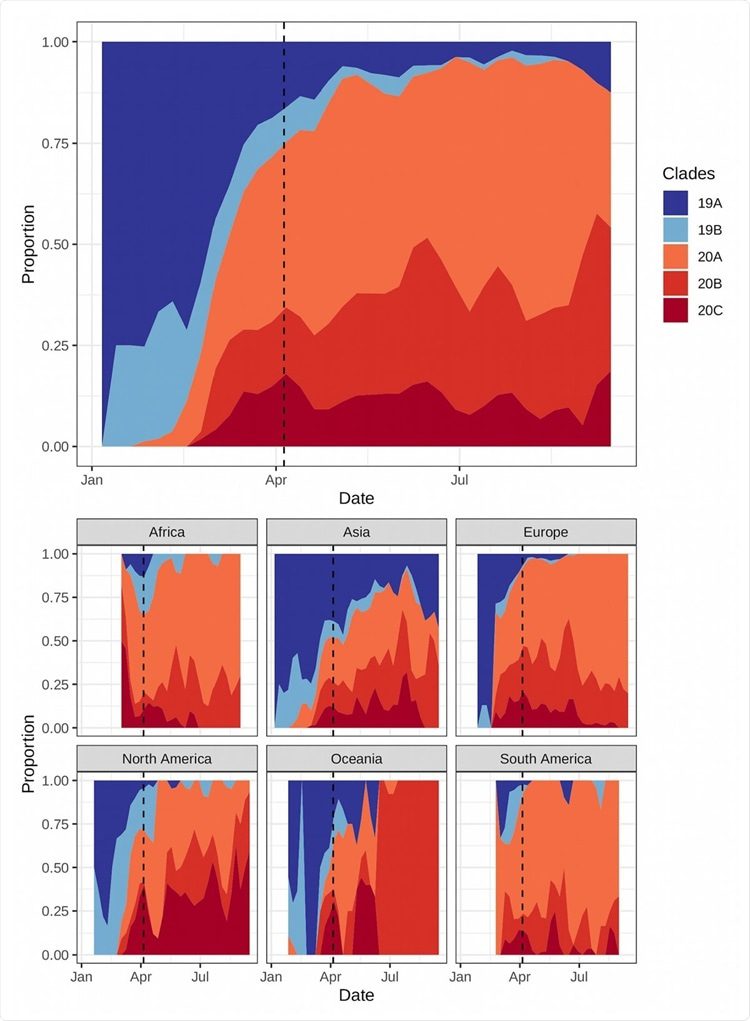
A new study conducted by researchers at the University of Connecticut has revealed a correlation between the prevalence of particular clades of severe acute respiratory syndrome coronavirus 2 (SARS-CoV-2) and the growth rate of the associated illness coronavirus disease 2019 (COVID-19).

Researchers found that models of early COVID-19 growth dynamics that included the different clades the virus has mutated into significantly improved growth rate predictions.

Including clades in the models was also more important than incorporating the SARS-CoV-2 variant D614G, which has been associated with increased viral load and infectivity.

More specifically, a higher prevalence of the clades 19A and 19B, which emerged during the Wuhan outbreak, correlated with lower growth rates. Higher prevalence of the clades 20A and 20C, which emerged from 19A and was prominent early on in the European outbreak, correlated with higher growth rates.

The researchers say that without intervention, COVID-19 has the potential to grow more quickly in regions dominated by the 20A and 20C clades, which includes most of South and North America.

Original study can be found on the medRxiv server and is currently under peer review: https://www.medrxiv.org/content/10.1101/2020.09.29.20202416v1


Daily Remedy

Daily Remedy

Dr. Jay K Joshi serves as the editor-in-chief of Daily Remedy. He is a serial entrepreneur and sought after thought-leader for matters related to healthcare innovation and medical jurisprudence. He has published articles on a variety of healthcare topics in both peer-reviewed journals and trade publications. His legal writings include amicus curiae briefs prepared for prominent federal healthcare cases.

Videos

Policy Shift in Peptide Regulation

Semaglutide and the Expansion Problem: When One Trial Becomes a Platform

Semaglutide and the Expansion Problem: When One Trial Becomes a Platform

Semaglutide has moved beyond its original indication and now sits at the center of a widening set of clinical questions: cardiovascular risk, kidney disease progression, and even neurodegeneration. The question is no longer whether the drug lowers glucose or reduces weight—it does—but how far those effects extend across systems, and whether evidence from one population can be translated into another without distortion. Large, well-powered trials have produced consistent signals, yet those signals are now being applied in contexts that were...

Read more

Join Our Newsletter!
